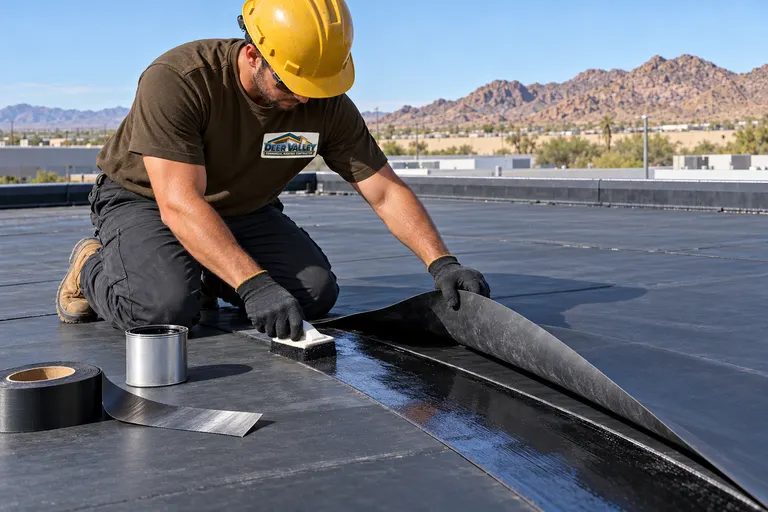
EPDM Roofing
Rubber EPDM makes sense when an old rubber roof needs one section rebuilt, since new sheets tie into the existing field instead of starting over.
EPDM roofing in Deer Valley
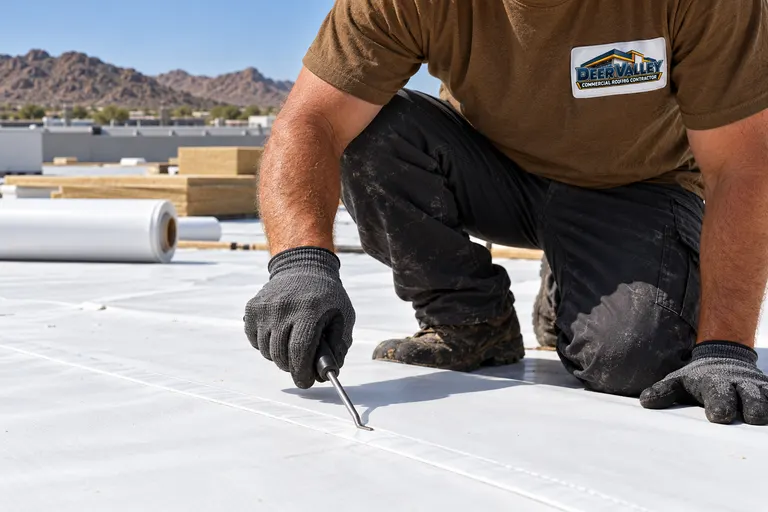
Single-Ply TPO Roofing
Your Deer Valley TPO roofing contractor for warehouses, retail centers, offices, and flex buildings. We install new white TPO, repair welded laps, and replace worn sheets.
Fit Check
TPO earns its place on flat decks over cooled space. The right column lists the roofs where another system serves the building better.
TPO Trouble Spots
This plan of a white TPO roof on a Deer Valley warehouse marks the spots we test before any repair or recover is priced.
Probing a lap with a seam tool finds spots where the hot-air welder ran too fast or the sheet was dirty, leaving a gap that opens under wind-driven rain.
Curbs and rooftop unit stands take the most foot traffic and movement, so the welded flashing at their corners splits before the field sheet does.
Membrane welded into the drain clamping ring pulls loose when the bowl settles, and water then follows the deck straight to the ceiling below.
Wind gusts during monsoon storms lift a loose sheet at the roof edge first, and a lifted edge can peel back several feet of membrane in one storm.
Service techs crossing to the units scuff a thin sheet down toward the scrim along the same path every visit, which is where walk pads belong.
Soft, raised areas over wet insulation show where water has already slipped under the TPO. Cores tell us how far the wet boards spread.
TPO Options
Four ways a TPO job can go, from a few welded patches to a full tear-off. Cores and a moisture check decide which one fits your roof.
| Option | When it fits | What the work involves |
|---|---|---|
| Repair | Leaks trace to a few laps, curbs, or drains and the insulation is dry | Cleaning the sheet, welding new TPO patches or flashing, and probing every new weld |
| Recover | One existing roof layer, dry insulation, and a deck in good shape | Cover board or insulation over the old roof, then a new fastened or adhered TPO sheet |
| Tear-off and replace | Wet boards across large areas, or two roof layers already in place | Removing the old roof to the deck in sections, new insulation, and a new welded TPO sheet |
| Thicker membrane | Roofs with heavy sun exposure and regular service traffic | A heavier TPO sheet with more material over the reinforcing scrim, plus walk pads |
What Changes
Here is what owners describe on a worn TPO roof, and what the same roof looks like once new sheets are welded in.
Chalky, thin surface
Older sheets worn down toward the scrim after years of UV.
Laps lifting at the edges
Seams that a probe slips into along the traffic path.
Split curb corners
Flashing torn where unit stands flex and techs step.
Ceiling stains below drains
Water running under loose membrane at the drain bowl.
Bright white sheet
A reflective surface that stays cooler than a dark membrane.
Probed welds
Every lap checked with a seam probe before sign-off.
Welded curb flashing
New corners formed and welded at each curb and stand.
Tight drain seals
Membrane clamped into each drain ring over dry insulation.
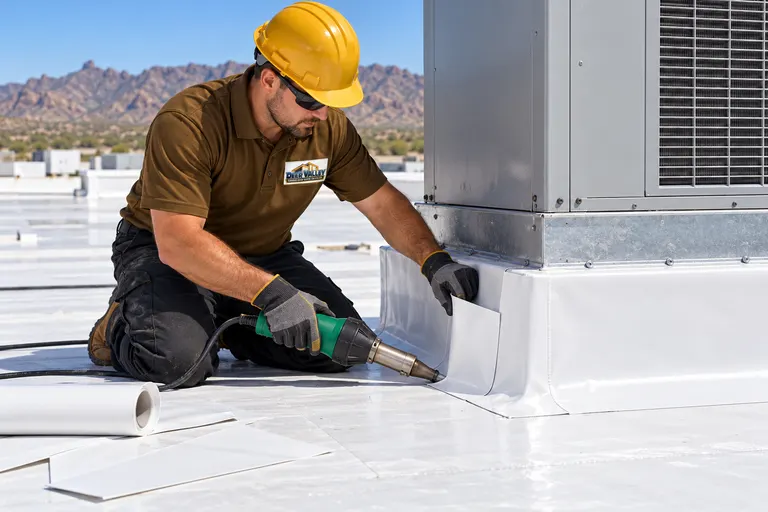
Open laps let monsoon rain under the sheet and into the insulation. A weld check this spring finds them while a patch still fixes the problem.
TPO Job Sequence
Each TPO job follows the same order, with the moisture findings deciding how much of the old roof comes off before new sheets go down.
A roofer probes the laps, cuts cores near drains and curbs, and maps soft areas so the scope accounts for wet insulation the surface hides.
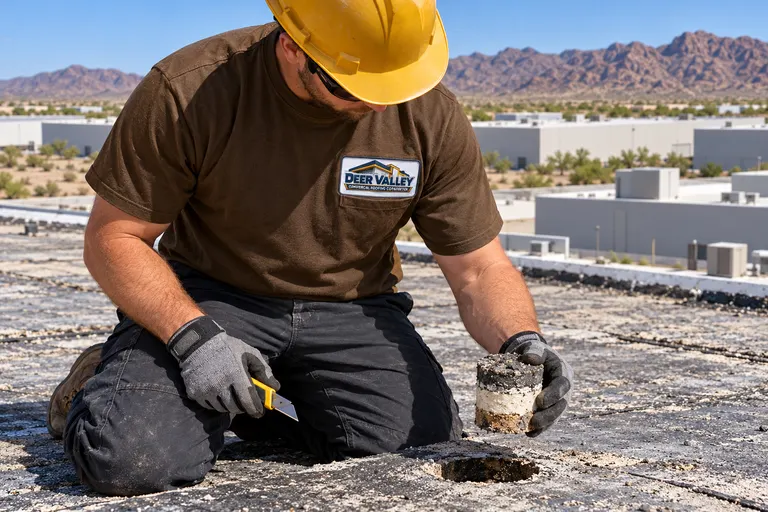
Dry insulation and a single roof layer allow a recover over the old sheet, while wet boards or a second layer send that area down to the deck.
New boards are fastened with plates, and the TPO goes down fastened, fully adhered, or induction-welded, chosen by deck type and wind exposure.
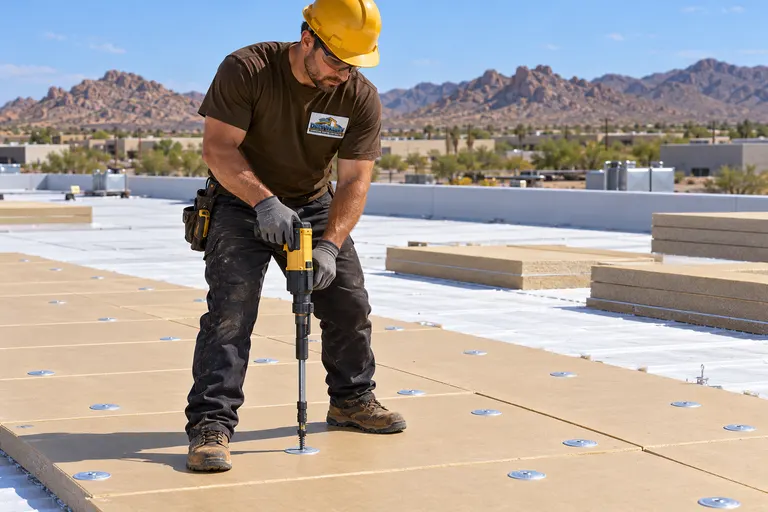
Hot-air welders fuse each lap into one sheet, then curbs, drains, and pipe stands get formed flashing welded to the field membrane.
Before sign-off, every weld gets a probe pass, edge metal gets a pull check, and photos of each new detail go into your building file.
Related Systems
Some Deer Valley buildings need a different sheet or a heavier approach. These two systems come up most often when TPO falls short.
Rubber EPDM makes sense when an old rubber roof needs one section rebuilt, since new sheets tie into the existing field instead of starting over.
EPDM roofing in Deer Valley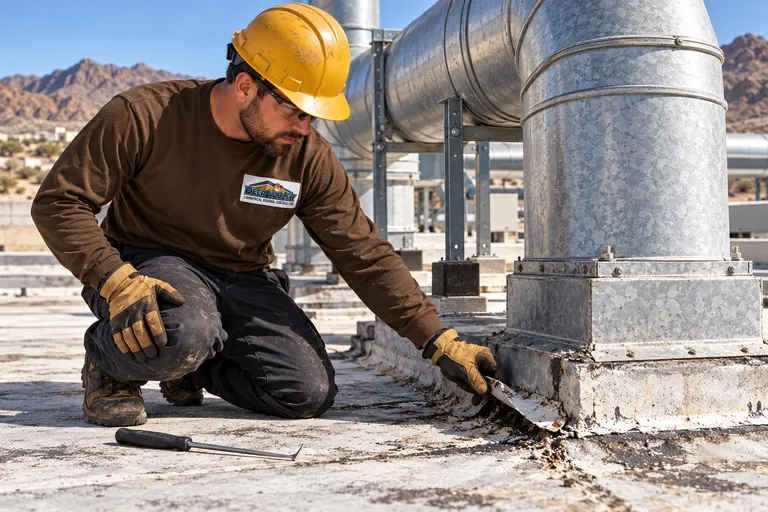
Hangars and plants with process ducts and heavy units call for phased work, walk pads, and drain checks across very wide spans.
industrial roofing in Deer ValleyTPO Questions
Yes. We install single-ply TPO on low-slope warehouses, retail centers, offices, and flex-industrial buildings across Deer Valley. The white sheet reflects much of the summer sun, and its hot-air welded laps fuse into one sheet. We watch the welds at curbs, drains, and unit stands, where movement and foot traffic concentrate.
Thicker is the safer pick on roofs with steady sun and service traffic. A heavier sheet puts more material over the reinforcing scrim, so surface wear takes longer to reach it. The roof walk shows how much traffic the units draw, which guides the thickness we price.
Neither wins on every building. Deck type and wind exposure decide it. Fastened sheets suit steel decks with new insulation, adhered sheets lie flat over cover board, and induction-welded plates hold the sheet with fasteners hidden under the membrane.
Repairs work well on TPO when the insulation is dry. New TPO welds to clean existing TPO, so split curb corners, open laps, and punctures get patched with matching material. Wide wet areas found in cores are the point where replacement makes more sense.
About 20 to 30 years is a common range. UV exposure, foot traffic, and poorly welded seams shorten it, while spring and fall checks with quick seam repairs push a roof toward the upper end. Treat the range as guidance, since every roof ages differently.
Drain bowls move. When the clamping ring loosens or the bowl settles, the membrane pulls away and water runs along the deck. Dust packed into the strainer adds ponding that pushes on that joint, so we reseal the ring and clear the outlet together.
It keeps the roof surface cooler than a dark membrane, which helps the space under it. How much that shows up on a power bill depends on insulation, the HVAC setup, and building use, so we describe it as a cooler roof and leave savings figures out.
Send the roof size and condition for a ballpark number on your TPO roof, or call to set up a roof walk and core check.
Leave a name and number and we will call you back. Or call now: (623) 310-0170