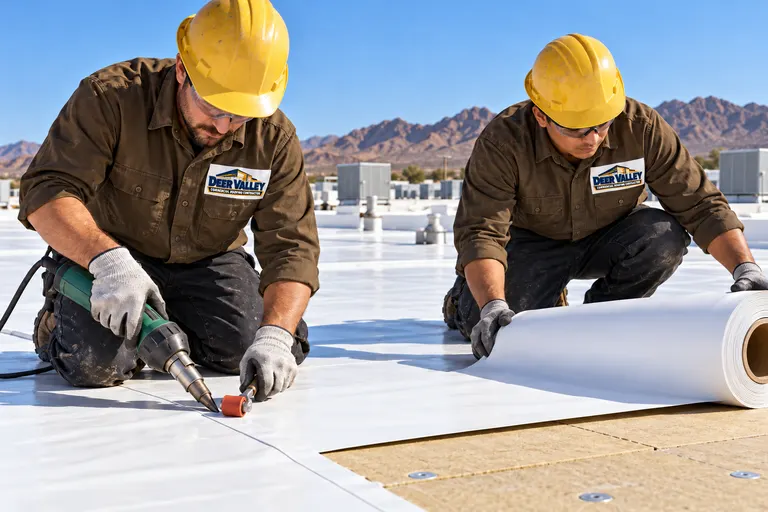
TPO Roofing
White TPO covers wide warehouse decks faster than rubber, with hot-air welded laps and a reflective surface over cooled space.
TPO roofing in Deer Valley
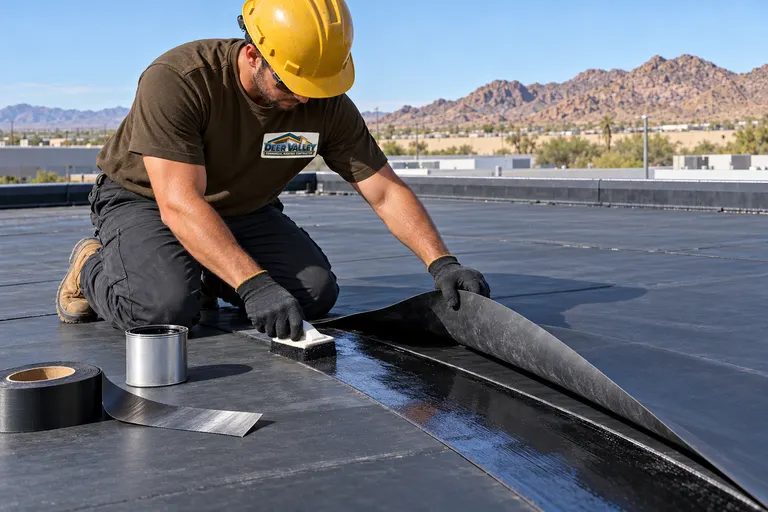
Rubber Membrane Roofing
Your Deer Valley EPDM roofing contractor for rubber roofs crowded with vents, curbs, and odd shapes. We install new EPDM, repair taped seams, and rebuild worn sections.
Fit Check
Rubber membrane handles crowded, irregular roofs well. The second column shows the buildings where TPO or metal answers the problem better.
EPDM Trouble Spots
This plan of an EPDM roof on a retail building marks the six details that leak before the rubber field sheet wears out.
Heat and UV dry out older seam adhesive, and the tape edge curls back far enough for wind-driven rain to work into the lap.
Rubber boots around vent pipes split where the clamp meets the collar, a common leak on roofs with many plumbing and gas penetrations.
Inside and outside corners at exhaust fans and small curbs carry the most stretch, so the corner patches lift before the flat flashing does.
Standing water sits on sagging deck areas, and the dust it leaves behind holds moisture against the laps long after the storm.
Fasteners along the wall termination bar back out as the rubber moves, and the sealant above the bar cracks in the summer sun.
Aged EPDM shrinks and pulls tight where the roof meets the wall, bridging the gap and tearing when the building flexes on a hot afternoon.
EPDM Options
From a single pipe boot to a full tear-off, these are the four ways EPDM work usually goes on a North Phoenix building.
| Option | When it fits | What the work involves |
|---|---|---|
| Seam and flashing repair | Leaks trace to curled tape, split boots, or loose termination bars over dry insulation | Cleaning and priming the rubber, new seam tape or cover strip, and new boots or corner patches |
| Section rebuild | One area of an existing rubber roof has wet boards or worn sheet | Cutting out that section, new insulation, and new EPDM tied into the old field sheet |
| Tear-off and replace | Wet insulation and failed laps across most of the roof | Removing the old roof in sections down to the deck and installing a new EPDM system |
| White-on-black EPDM | Rubber roofs over cooled offices or retail space | A sheet with a white top surface, or reflective surfacing over standard black rubber |
What Changes
These are the conditions owners point out on an aging rubber roof, and how the same roof reads after new EPDM goes on.
Curled seam tape
Lap edges lifting along the walking path to the units.
Cracked pipe boots
Splits at the clamp on vents and gas lines.
Torn wall base
Rubber pulled tight and split where the roof meets the wall.
Patched corners
Layers of lap sealant over fan curbs that keep reopening.
Primed, taped laps
Seams cleaned, primed, and rolled before the tape sets.
New pipe boots
Fresh boots and clamps at every penetration.
Relaxed wall flashing
New flashing laid in with room to move at the base.
Formed corner patches
Molded or field-formed corners at each curb.
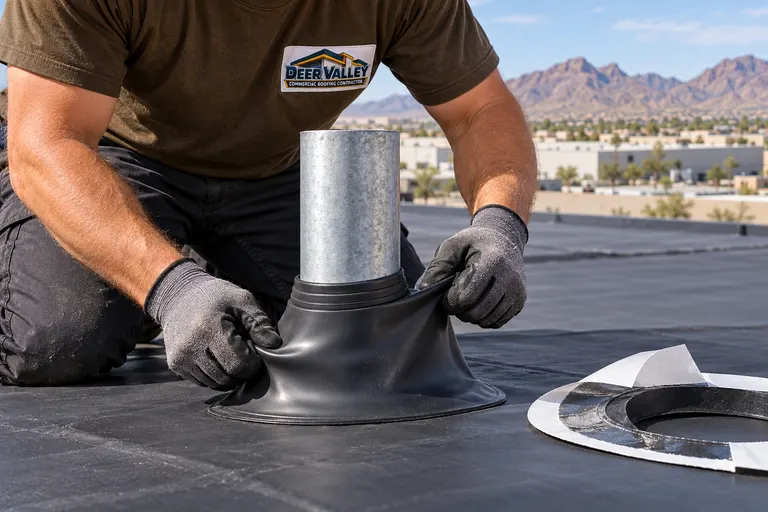
Split pipe boots are the most common rubber roof leak on buildings with lots of plumbing and gas lines. A seam and boot check catches them before the ceiling tiles do.
EPDM Job Sequence
Rubber roofing depends on clean, primed laps and careful detailing, so most of the time on an EPDM job goes into seams, boots, and corners.
Each lap gets a hand check for curled tape, each boot and corner is looked at closely, and cores near low spots show whether the insulation is still dry.
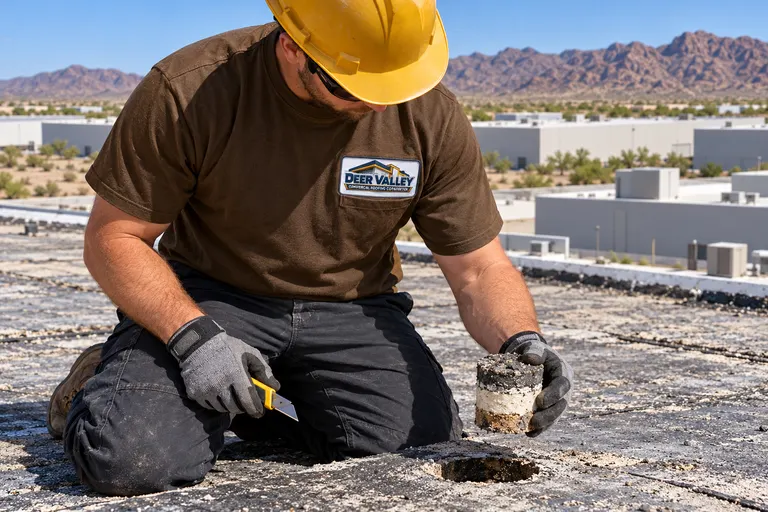
Findings go onto a roof plan, separating seams and boots that take a repair from sections where wet boards mean cutting out the old rubber.
Old membrane and wet insulation come off one area at a time, with tarps over the rest so the building below stays dry overnight.
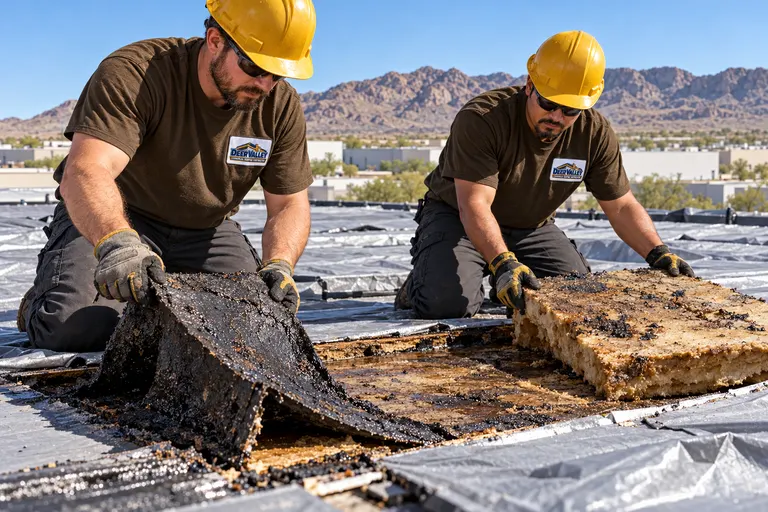
Laps are scrubbed, primed, taped, and rolled, then boots and corner flashing go on at every vent, fan, and curb before the next area opens.
Before the crew packs up, a roofer walks each lap edge and boot clamp, clears the drains, and photographs the details for your building file.
Related Systems
Some Deer Valley roofs call for a different system. These two take over when the deck is wide open or the building has real pitch.
White TPO covers wide warehouse decks faster than rubber, with hot-air welded laps and a reflective surface over cooled space.
TPO roofing in Deer Valley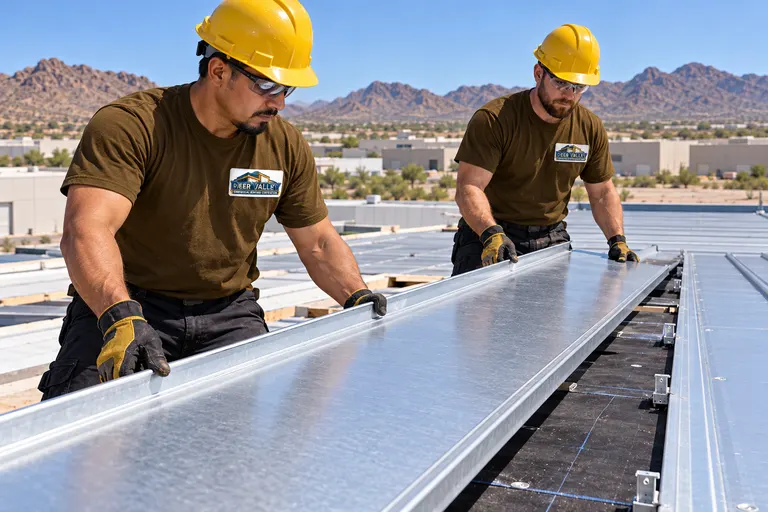
Pre-engineered steel buildings with enough slope shed water on metal panels, and damaged panels can be swapped in sections.
commercial metal roofing in Deer ValleyEPDM Questions
It can be, especially on roofs with complicated layouts or many penetrations. Rubber stays flexible through big day-to-night swings. Standard black EPDM absorbs heat, so white-on-black EPDM or reflective surfacing is worth comparing over cooled space. EPDM also fits when an old rubber roof needs one section rebuilt.
With primer and seam tape. Each lap is scrubbed clean, primed, taped, and rolled so the tape bonds across its full width. Most seam leaks we find trace back to laps that were never cleaned or rolled, so prep gets as much time as the tape.
Yes, when the old sheet is still pliable. Aged rubber gets cleaned and primed so cover tape and new flashing bond to it. Where the old sheet has gone brittle or shrunk at the walls, a section rebuild holds better than patches.
Pipe boots age faster than the field sheet. The collar splits at the clamp, or the clamp loosens as the pipe moves, and rain runs straight down the pipe. A new boot and clamp at each penetration is a short repair on most roofs.
About 25 to 30 years is a common range for EPDM, and heat aging of seams and flashing is what shortens it in Deer Valley. Twice-yearly checks and quick seam repairs help a rubber roof reach the upper end.
On a dry, well-attached sheet, often yes. Reflective surfacing over black rubber cuts the heat the roof surface absorbs. The sheet gets cleaned and checked first, because surfacing over loose laps or wet insulation hides problems instead of fixing them.
Units inside the section being worked are shut down with your facility team, flashed, and restarted before that section closes. Gas lines and condensate drains get new boots or flashing at the same time, so each penetration is handled once.
Send the roof size and condition for a ballpark number on your rubber roof, or call to set up a seam and boot check.
Leave a name and number and we will call you back. Or call now: (623) 310-0170