Commercial Roofing Questions
Commercial Roofing Questions In Deer Valley
Deer Valley is a City of Phoenix urban village with a lot of commerce and industrial land, and the city-owned Phoenix Deer Valley Airport sits at its center.
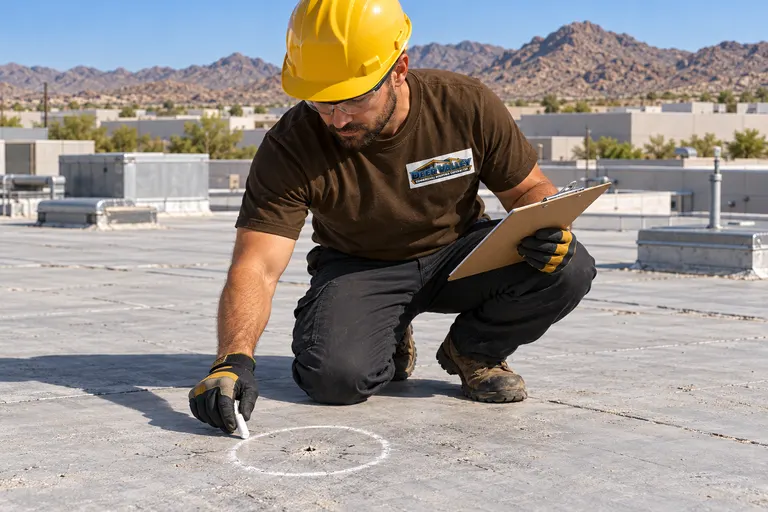
Low-Slope Roof Taking A Beating?
Hangars, flex-industrial buildings, warehouses, and shopping centers here carry low-slope roofs through long summers of hard sun and sudden monsoon storms. We install and repair TPO, EPDM, industrial, and metal roofs on those buildings.
Answers By Topic
Deer Valley Commercial Roofing Questions By Topic
- Roof Systems
- Heat, Storms, And Roof Condition
- Permits, Planning Rules, And Taxes
- Planning The Work
- Service Areas
Roof Systems
Do you install TPO roofing on Deer Valley commercial buildings?
Yes. We install single-ply TPO on low-slope warehouses, retail centers, offices, and flex-industrial buildings across Deer Valley. A white TPO sheet reflects much of the summer sun, which keeps the roof surface cooler than a dark membrane.
TPO seams are heat-welded with hot air, so the laps fuse into one sheet instead of relying on adhesive tape. On a Phoenix roof, we pay close attention to:
- Seam welds at curbs, drains, and rooftop unit stands, where foot traffic and movement concentrate.
- Membrane thickness, since a heavier sheet gives more material between the sun and the scrim.
- Attachment method, picked from mechanically fastened, fully adhered, or induction-welded options based on the deck and wind exposure.
Is EPDM still a good choice for a Phoenix commercial roof?
EPDM can work well here, especially on roofs with complicated layouts or a lot of penetrations. It is a rubber membrane that stays flexible through big day-to-night temperature swings.
Standard EPDM is black and absorbs heat. For buildings where cooling cost matters, white-on-black EPDM or a reflective surfacing are options worth comparing. EPDM is also a common choice when an existing rubber roof only needs a section rebuilt, since new material can tie into the old field sheet.
What does an industrial roofing contractor handle around Deer Valley Airport?
Industrial roofing covers large-footprint buildings such as hangars, distribution warehouses, manufacturing plants, and aviation service shops. These roofs tend to have wide spans, heavy rooftop equipment, and exhaust or process penetrations.
The city's Deer Valley village page describes considerable commerce and industrial land around the airport, so this building type is common here. On these jobs we focus on:
- Drain capacity across big roof areas, where a single clogged drain can pond water over thousands of square feet.
- Equipment curbs and pipe supports, which often leak before the field membrane does.
- Walk pads along service routes so maintenance crews don't wear through the membrane.
- Phasing, so production lines, loading docks, and hangar doors keep working while each section is roofed.
When does commercial metal roofing make sense in North Phoenix?
Metal fits buildings with enough slope to shed water, such as pre-engineered steel warehouses, shops, and some retail canopies. Standing-seam and through-fastened panels are both common on these structures.
In this heat, metal panels expand and contract daily. We check fastener backouts, sealant at laps, and panel clips, because thermal movement loosens them over time. A painted or reflective finish also helps keep the panel surface cooler than bare metal.
Metal is a poor fit for a dead-flat roof. On those, a membrane system such as TPO or EPDM usually performs better.
Which roof system fits my building type?
The right system depends on slope, rooftop traffic, penetrations, and how much heat the building takes on. A starting point we use during inspections:
| Building type | Common fit | Why |
|---|---|---|
| Low-slope warehouse or distribution center | TPO | Reflective, heat-welded seams, efficient on large flat areas |
| Office or retail with many rooftop units | TPO or EPDM | Both detail well around curbs and penetrations |
| Aircraft hangar or manufacturing plant | TPO, EPDM, or metal | Depends on deck type, slope, and process exhaust |
| Pre-engineered steel building with pitch | Metal | Sheds water fast; panels can often be repaired or replaced in sections |
| Older roof needing a partial rebuild | Match the existing system | Ties new material into the old field cleanly |
An inspection settles the final choice, because deck condition and existing layers often narrow the options.
How long do TPO, EPDM, and metal roofs last here?
Service life varies with installation quality, maintenance, and exposure, so treat these ranges as general guidance rather than promises:
| System | Typical range | What shortens it in Deer Valley |
|---|---|---|
| TPO | About 20–30 years | UV exposure, foot traffic, poorly welded seams |
| EPDM | About 25–30 years | Heat aging of seams and flashings |
| Metal | 40+ years in many cases | Loose fasteners, failed sealant, corrosion at cut edges |
Regular inspections and quick repairs push a roof toward the upper end of these ranges.
Heat, Storms, And Roof Condition
How does Phoenix heat affect commercial roof membranes?
Sustained heat and UV are the main forces aging roofs in Deer Valley. They dry out sealants, stress seams, and make membranes and metal expand and contract every day.
Common heat-related problems we find:
- Shrinking flashings that pull away from parapet walls and curbs.
- Brittle sealant at pitch pans, termination bars, and metal laps.
- Blistering where moisture trapped under the membrane expands in the sun.
- Surface wear on older EPDM and on TPO near the end of its service life.
Roofing crews also face heat-safety limits in summer, so we often schedule work in early-morning shifts.
What should building owners expect from monsoon season?
The City of Phoenix lists the monsoon as running June 15 to September 30, with storms peaking from mid-July to mid-August. Those storms bring strong gusts, blowing dust, and short bursts of heavy rain.
On low-slope roofs, the biggest risks are wind lifting loose membrane edges and debris blocking drains so water ponds. The city specifically advises clearing roof drains and scuppers before storms. We recommend a pre-season check in late spring and a quick look after any major storm. The NWS Phoenix forecast office posts local storm warnings.
Should I repair or replace my commercial roof?
Repair usually makes sense when damage is limited to specific spots and the membrane and insulation are mostly dry. Replacement becomes the better option when problems are widespread or the insulation underneath is saturated.
| Sign | Usually repair | Usually replace |
|---|---|---|
| Leaks at one or two curbs or drains | Yes | |
| Isolated seam failures | Yes | |
| Wet insulation across large areas | Yes | |
| Widespread brittle or cracked membrane | Yes | |
| Rusted-through metal panels in many bays | Yes | |
| Two existing roof layers already in place | Often, since code may limit another recover |
A moisture survey or test cuts during the inspection show how much of the roof is still sound.
How often should a Deer Valley commercial roof be maintained?
Plan on inspections at least twice a year: once in spring before monsoon season and once in fall after it ends. Add a check after any major windstorm or hail event.
A solid maintenance visit includes:
- Clearing drains, scuppers, and gutters of dust and debris.
- Checking seams, flashings, and penetrations for separation.
- Looking for ponding, punctures, and storm damage.
- Tightening or replacing loose metal fasteners and sealant.
- Recording findings with photos for your building file.
Permits, Planning Rules, And Taxes
Do I need a permit to reroof a commercial building in Deer Valley?
In most cases, yes. Commercial roofing in Deer Valley falls under City of Phoenix Planning & Development, which issues permits for nonresidential work. The city also has an over-the-counter reroofing application that asks whether the job is a tear-off or a recover.
The permit authority depends on whether the property is inside Phoenix city limits or in unincorporated Maricopa County:
| Area | Jurisdiction | Permit authority |
|---|---|---|
| Deer Valley | City of Phoenix urban village | City of Phoenix Planning & Development |
| North Mountain | City of Phoenix urban village | City of Phoenix Planning & Development |
| North Gateway | City of Phoenix urban village | City of Phoenix Planning & Development |
| Desert View | City of Phoenix urban village | City of Phoenix Planning & Development |
| Anthem (east of I-17) | Unincorporated Maricopa County | Maricopa County Planning & Development |
| Anthem Parkside (west of I-17) | City of Phoenix | City of Phoenix Planning & Development |
| New River | Unincorporated Maricopa County | Maricopa County Planning & Development |
| Desert Hills | Unincorporated Maricopa County | Maricopa County Planning & Development |
Maricopa County takes building applications online through its Permit Center. Requirements change, so we confirm the current rules with the right office before each project.
Are there extra planning rules near Deer Valley Airport?
Possibly, for some parcels. The Phoenix Zoning Ordinance includes a Deer Valley Airport Overlay, and North Gateway has its own overlay districts and scenic corridors. These mostly govern land use and building height, so a like-for-like reroof is rarely affected.
Work that adds height, such as new rooftop equipment screens, is worth checking against the overlay. We don't know of a historic or design review that applies to typical industrial reroofs in these villages.
Can a new commercial roof qualify for Section 179?
It can. Under Section 179, roofs on existing nonresidential buildings may count as qualified real property, which lets a business expense the cost in the year the roof goes into service rather than depreciating it over decades.
Key points from IRS Publication 946:
- 2026 deduction limit: $2,560,000.
- Eligible buildings: nonresidential commercial property, such as warehouses, offices, hangars, and retail buildings.
- Excluded: residential rental property.
Tax situations differ, so talk to your CPA before planning around this deduction.
Does APS offer incentives for cool or reflective roofs?
APS (Arizona Public Service) runs a Solutions for Business program with rebates for some building upgrades, but its current materials don't list a roofing-specific rebate. Its page also says funding for Existing Facilities rebates is fully allocated, with a waitlist open.
Programs change often, so we never count on a rebate when planning a roof. Confirm your utility on your bill, and check APS Solutions for Business for current offerings. Programs that reward reflective roofing often require products rated in the CRRC Rated Roof Products Directory.
Planning The Work
Can you roof our building without shutting down operations?
Usually, yes. We plan the work in sections so tenants, production lines, and hangar activity can keep going while crews work overhead.
Typical ways we limit disruption:
- Phased sections so only one area of the roof is open at a time.
- Early-morning starts in summer, which also cut heat exposure for crews.
- Coordinated equipment shutdowns with your facility team when rooftop units must be disconnected.
- Protected entrances and loading docks while material moves up to the roof.
- Odor and fume planning for adhesives near air intakes, with low-odor products where practical.
How do I get started?
Call us or request a free estimate to set up a commercial roof inspection. We walk the roof and look at the conditions that decide whether repair or replacement makes sense.
The inspection checks:
- Membrane or panel condition, including seams, laps, and surface wear.
- Flashings and penetrations at curbs, pipes, parapets, and edges.
- Drainage, with signs of ponding and drain or scupper blockage.
- Moisture in the insulation, where needed.
- Existing layers and deck condition, which affect what can be installed.
Afterward, we walk you through what we found and the roofing options that fit your building.
Service Areas
What areas do you serve?
We work on commercial buildings throughout Deer Valley and nearby North Phoenix and north Maricopa County communities, including:
Sources
- City of Phoenix: Deer Valley Village
- City of Phoenix: Urban Villages
- City of Phoenix: North Gateway Village
- City of Phoenix: Commercial Plan Reviews and Permits
- City of Phoenix: Reroofing Over-the-Counter Permit Application (PDF)
- City of Phoenix: Airports
- City of Phoenix: Storms and Monsoon Information
- Maricopa County: Construction Permit Information
- Maricopa County: Commercial Construction
- Anthem Community Council: Our Community
- National Weather Service Phoenix
- IRS Publication 946
- APS Solutions for Business
- CRRC Rated Roof Products Directory
Still Have A Roof Question?
Call with the question, or send the roof size and condition for a free ballpark estimate.