TPO Roofing
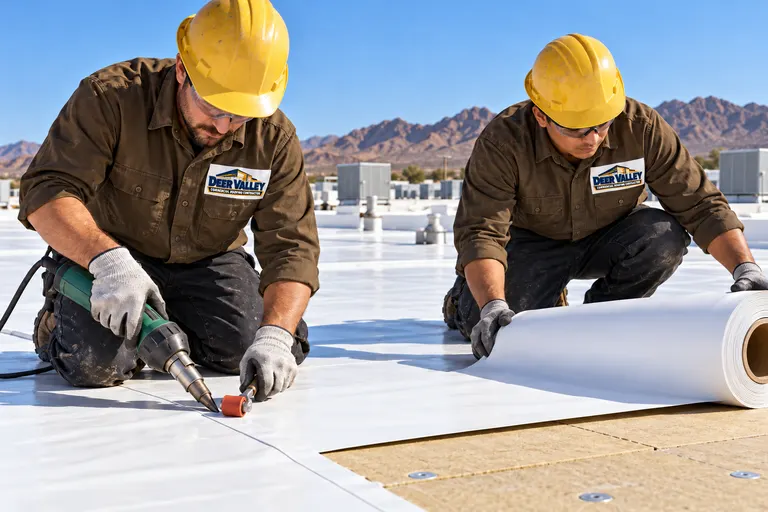
Wide flat decks over warehouses and plants take white TPO well, with welded laps that hold up to wind-driven monsoon rain.
TPO roofing in Deer Valley
Hangars, Plants, Warehouses
Your Deer Valley industrial roofing contractor for hangars, distribution warehouses, and plants near the airport. We install, repair, and replace wide-span roofs in phases.
Fit Check
Industrial work covers large, busy roofs where equipment and operations shape the job. The right column lists buildings that need a simpler scope.
Industrial Trouble Spots
This plan of a hangar-style industrial roof marks the six spots that cause most leaks on large Deer Valley buildings.
One clogged drain on a roof this size can pond water over thousands of square feet, so drain capacity and strainers get checked across every bay.
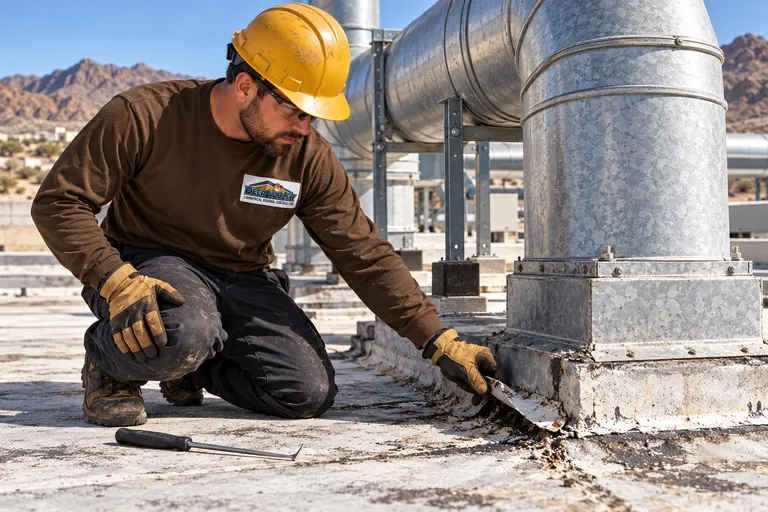
Flashing at the base of exhaust and process ducts takes heat, vibration, and fumes, and it often cracks well before the field membrane.
Large rooftop units sit on curbs and pipe supports that move with the building, and those flashings leak earlier than open roof areas.
Maintenance crews walk the same line to the units every week, wearing a groove into the membrane wherever walk pads were never laid.
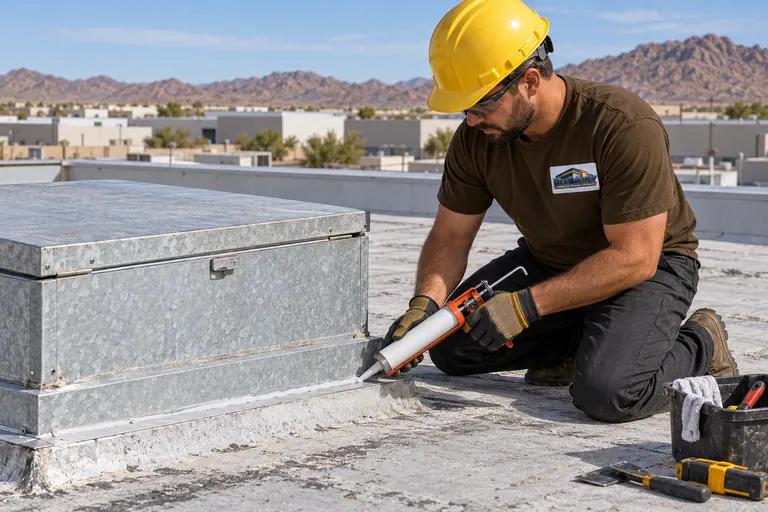
Hatches see daily use, and the curb flashing around them takes boot heels, dropped tools, and sun on all four sides.
Water off the long wall collects at the edge above the hangar door, so the edge metal and gutter line there get extra fastening and flashing.
Industrial Options
Industrial jobs range from a curb repair to phasing a full roof replacement around production. These four cover most of what we price.
| Option | When it fits | What the work involves |
|---|---|---|
| Targeted repair | Leaks at a few duct bases, curbs, or drains over dry insulation | New flashing at the failed details, drain resets, and walk pads where traffic crosses |
| Phased recover | One dry roof layer under a worn membrane on a large building | New cover board and membrane laid one section at a time around operations |
| Phased tear-off and replace | Wet insulation across bays, or two existing layers | Removing and replacing the roof bay by bay, each section closed before the next opens |
| Metal roof work | Pitched pre-engineered buildings in the same complex | Panel, fastener, and lap work matched to the steel roof sections |
What Changes
These are the conditions facility managers report on worn industrial roofs, and how those roofs read after the work is phased through.
Leaks over production
Drips near duct bases and curbs above work floors.
Grooves on service routes
Membrane worn thin along paths to the units.
Ponding across bays
Water held behind a single slow drain.
Cracked duct flashing
Splits at exhaust bases from heat and vibration.
Walk pads on every route
Protection laid along the paths maintenance crews use.
Reset drains
Strainers cleared and drain rings resealed across each bay.
New duct and curb flashing
Fresh membrane at stacks, ducts, and pipe supports.
Dry sections
Wet boards replaced bay by bay over the work floor.
A drip over equipment or aircraft needs a close look at the duct bases, curbs, and drains above it. Call and describe where the water shows up inside.
Industrial Job Sequence
Large roofs get split into sections that match your production lines, docks, and hangar doors, and only one section is open at a time.
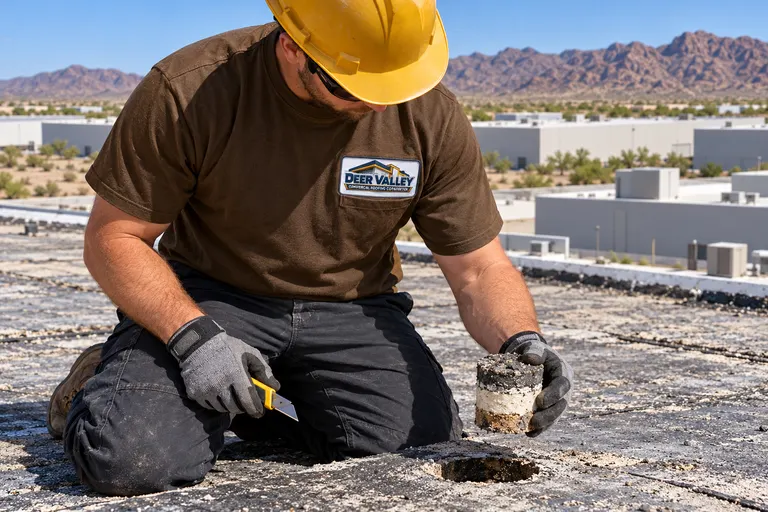
A roofer walks every bay, cores near drains and duct bases, and maps wet areas, worn paths, and failed flashing onto a plan of the roof.
Sections are drawn around production lines, loading docks, and hangar doors, and unit shutdowns are scheduled with your staff before any work starts.
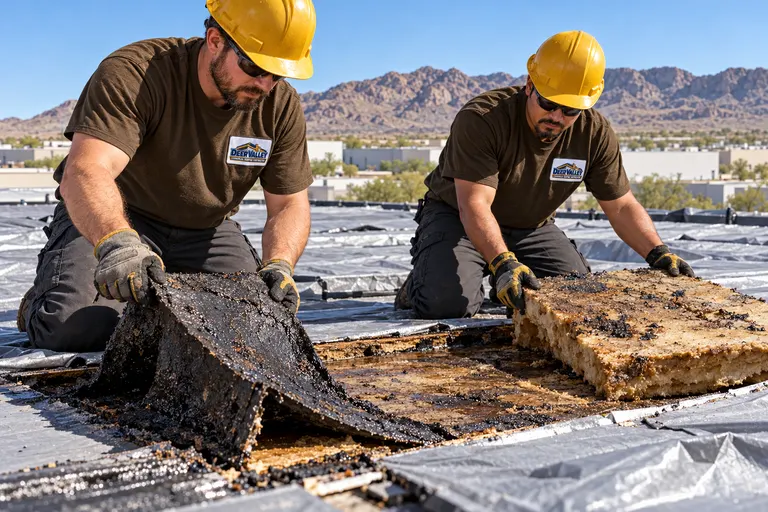
Crews remove the old roof from one section, install new insulation and membrane, and close it watertight before the next section opens.
Process ducts, pipe supports, unit curbs, and roof hatches get new flashing tied into the new membrane as each section reaches them.
Walk pads go down on the service routes, drains are cleared bay by bay, and a final roof walk is photographed for your maintenance records.
Related Systems
Most industrial roofs around the airport end up as TPO or metal. These two systems carry the bulk of that work.
Wide flat decks over warehouses and plants take white TPO well, with welded laps that hold up to wind-driven monsoon rain.
TPO roofing in Deer Valley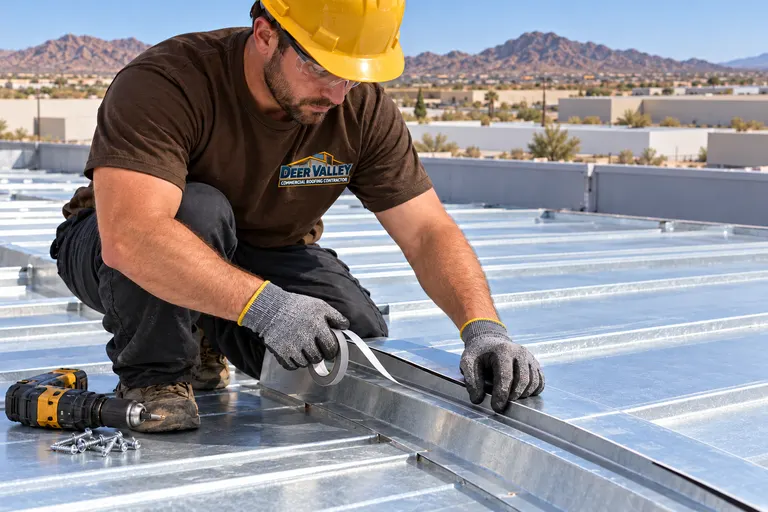
Pitched steel buildings in an industrial complex take metal panel work, from fastener and lap repairs to replacing panels in sections.
commercial metal roofing in Deer ValleyIndustrial Questions
Large-footprint buildings such as hangars, distribution warehouses, plants, and aviation service shops, with wide spans, heavy units, and process penetrations. The City of Phoenix village page notes considerable industrial land around the airport.
On these roofs we focus on drain capacity, curbs and pipe supports, walk pads on service routes, and phasing so docks and hangar doors keep working.
Mostly. The roof above the door header is phased so it is open as briefly as possible, and that section is scheduled with your operations staff. Material lifts and staging stay clear of the apron areas you name ahead of time.
By keeping only one section open and closing it watertight before quitting time. Tarps cover open areas, debris goes down by chute away from doors, and adhesives with strong odors stay away from air intakes or get swapped for low-odor products where practical.
Maintenance crews cross to the same units week after week. Without pads, their boots wear the membrane thin along that path, and the worn strip becomes a leak line. Pads spread the traffic and give the techs a clear line to follow.
Some exhaust wears on membrane and flashing around stacks, especially where grease or chemicals settle. We note what each stack vents during the inspection and pick flashing details and protection around the stack that hold up to it.
Drain capacity has to match the roof area each drain serves. On wide bays, one slow drain backs water over a large area, so we check each strainer and outlet and look at overflow scuppers where the parapet allows them.
Only while their curbs are being flashed. Each shutdown is set with your facility team, and units serving critical areas are worked first thing in the morning so they are back on before the afternoon heat.
Send the roof size and condition for a ballpark number on your hangar, plant, or warehouse roof, or call to walk the roof with us.
Leave a name and number and we will call you back. Or call now: (623) 310-0170